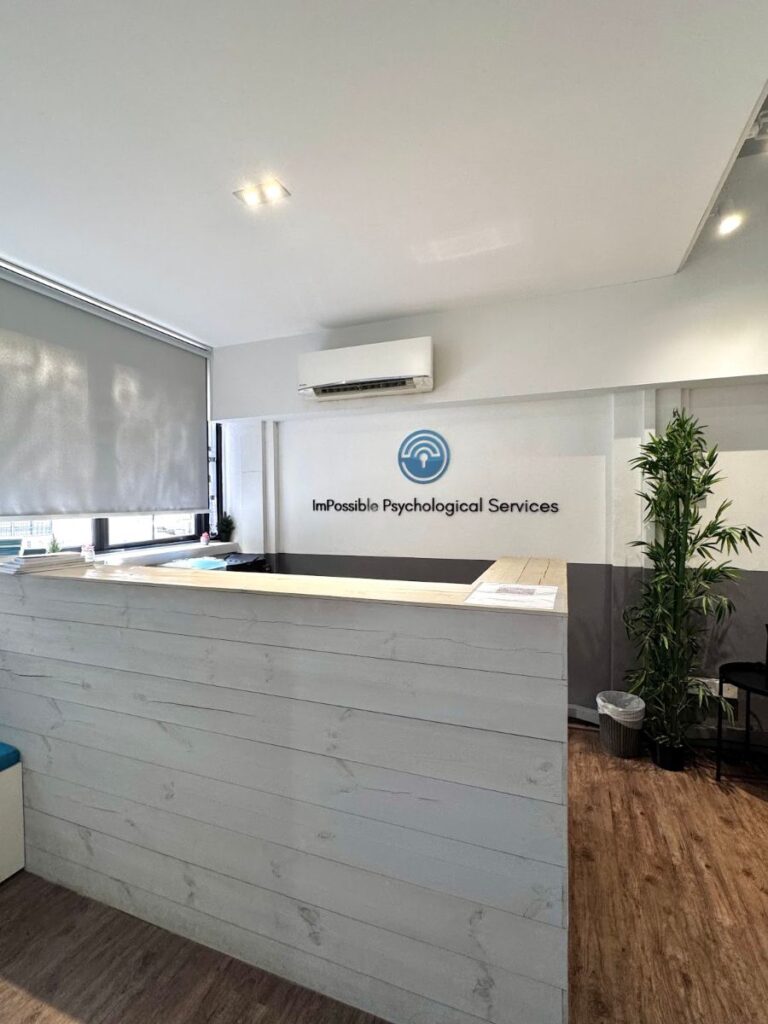
Read our name again. ImPossible. That is the whole idea.
Whatever you are carrying right now, whether it is anxiety that will not switch off, a marriage that has gone quiet, a child who has stopped talking to you, or a version of yourself you no longer recognise, the work of therapy is to find the strengths already in you and make the impossible possible.
We are a private psychotherapy and counselling practice on Joo Chiat Road. Our registered clinical psychologists, counselling psychologists and counsellors work with adults, couples, children and adolescents, using evidence-based approaches matched to you rather than to a formula.
We publish our rates. And through our Subsidised Psychotherapy Programme, sessions are available at $50 if regular fees are what is standing between you and getting help.
Psychotherapy is a structured, evidence-based treatment for psychological difficulty, delivered by a trained clinician over a series of sessions. Counselling generally refers to shorter-term, more focused support for a specific life problem. In practice the two overlap heavily, and in Singapore the words are often used interchangeably.
At ImPossible we offer both psychotherapy and counselling, and at your first session we will tell you honestly which one your situation calls for.
The distinction that actually matters to you is not the label but three other things:
A registered psychologist has completed a Master's or Doctorate and can conduct formal psychological assessment. A registered counsellor holds a Master's in counselling and works therapeutically without formal diagnosis.
An evidence-based framework such as CBT or Schema Therapy, applied deliberately, is different from unstructured conversation.
The relationship between you and your therapist is one of the strongest predictors of whether therapy works. This is not a soft factor. It is the factor.
A note on medication. We are a psychology and counselling practice, not a psychiatric one, so we do not prescribe medication. Where medication may help, we refer you to a psychiatrist and continue the therapeutic work alongside them. Many people do best with both.

Individual therapy for anxiety, depression, trauma, chronic stress and burnout, self-esteem, grief, anger, and the life transitions that unsettle everything: career change, migration, divorce, illness, becoming a parent, losing one.
You do not need a diagnosis to come. Most of our adult clients arrive because something is not working and they are tired of managing it alone.
Adult counselling services
For couples dealing with communication breakdown, recurring conflict, loss of intimacy, infidelity and rebuilding trust, parenting disagreements, financial stress, or the question of whether to stay.
We use the Gottman Method, Emotion-Focused Therapy, Couple Schema Therapy and Cognitive Behavioural Couples Therapy, selected to fit your relationship rather than applied off a shelf.

Therapy for children and young people navigating anxiety, low mood, emotional regulation, behavioural difficulties, school stress and refusal, bullying, friendship difficulty, and family change.
We work as closely with parents as with the child. For younger children, much of the intervention is delivered through you.
Child and adolescent services
Formal diagnostic and psycho-educational evaluations for children and adults, identifying cognitive, emotional, developmental and behavioural profiles. Common reasons include suspected ADHD, specific learning differences, and cognitive assessment.
For school-age children, our reports are written to support applications to schools and the Ministry of Education for examination Access Arrangements and Mother Tongue Language exemptions.

Workshops, talks and psychological support for organisations, covering stress and burnout, psychological safety, team dynamics, managing difficult conversations, and supporting employees through crisis.
Corporate servicesWe do not run every client through the same model. Your therapist selects and combines frameworks based on what you are dealing with, how you think, and what you are willing to try.
The most extensively researched approach for anxiety and depression. Identifies the thought patterns driving distress and tests them against reality, then builds behavioural change on top.
For long-standing patterns that keep repeating across relationships and jobs. Examines how early experiences formed the beliefs you now hold about yourself, and works to change them at that level rather than symptom by symptom.
Focuses on the choices you are making now and the needs those choices are meeting, then builds better strategies. Practical, present-focused, and effective for people who find extended exploration of the past frustrating.
Treats difficulty as belonging to a system rather than an individual. Relevant when the same conflict recurs regardless of who is involved, or when one person's difficulty is holding a family pattern in place.
Used in couple work to manage conflict, rebuild trust and restore emotional connection.
Our name is our method. Most people arrive focused entirely on what is wrong with them.
A significant part of the work is identifying the capabilities you already have and have stopped noticing. This is not positive thinking. It is the difference between treating a person and treating a problem.
Psychologists and counsellors in Singapore are not licensed under the Ministry of Health, which means the titles are not legally protected and anyone can use them.
Our clinicians hold Master's and Doctoral qualifications and are registered with the Singapore Psychological Society, the Singapore Register of Psychologists, or the Singapore Association for Counselling. Every clinician's qualifications and registrations are published individually on our team page. Verify them.
English, Mandarin, Malay and Tamil. People express difficult emotion most accurately in the language they grew up in, and being asked to translate your own grief into a second language costs something. If you would rather not, you do not have to.
Our rates are on the site, not behind an enquiry form. If cost is a barrier, you can request an associate psychologist or associate counsellor at a lower fee. And if a subsidised service would serve you better than we can, we will tell you where to go.
You are matched to a therapist based on your presenting concern, preferred language and preferred approach, and you see the same person throughout. If the fit is wrong, we change it without fuss.
Second floor of a shophouse on Joo Chiat Road. The entrance is positioned for privacy. Five minutes from Marine Parade MRT, on multiple bus routes, with a carpark directly opposite.
Cost is the most common reason people in Singapore delay therapy, so we did something about it. Since 2023 we have run a Subsidised Psychotherapy and Counselling Programme at $50 per session, for people for whom regular private fees are the obstacle to getting help.
$50 per session. No means test, no lengthy application. You tell us that regular fees are a barrier and we put you in the programme.
Sessions are conducted by an associate psychologist or a Master's-level trainee counsellor or psychologist completing the supervised practicum required for registration as a Registered Counsellor or Registered Psychologist. Every case is supervised by a senior clinician in the practice.
The programme covers:
An additional $10 surcharge applies to weekend and after-hours sessions.
Why this is not a lesser service. Supervised trainee and associate clinicians are current in their training, highly motivated, and their work is reviewed case by case by a senior clinician. What you give up is years of accumulated experience. What you gain is scrutiny, and a fee you can sustain for as many sessions as the work actually needs, which matters more than seniority for most presenting concerns.
Rates vary with the qualifications and experience of the clinician. Sessions outside regular hours and on weekends carry an additional $40 per hour.
Everything in this section is verifiable. Because psychologists in Singapore are not MOH-regulated, we think publishing this is not optional.
Our clinicians hold Master's or Doctoral qualifications in clinical psychology, counselling psychology or counselling, with registrations including:
Individual qualifications and registrations are published on every clinician's profile. Associate and supervised clinicians are labelled as such rather than obscured.
Held by our senior clinical psychologist and founder, Muhammad Haikal Bin Jamil:
Advanced Level ISST certification is the senior tier of schema therapy accreditation internationally, and the Supervisor designation means he is qualified to train and certify other clinicians in it. He is also a certified couple schema therapist, accredited at the Advanced Level.
This is the credential that separates a practice from a practitioner. Our clinicians are not only in practice, they teach the people who practise.
Our clinicians are approached by Singapore's national media for expert commentary on mental health. Our founder, Muhammad Haikal Bin Jamil, has contributed to CNA TODAY's Mental Health Matters and Gen Zen series.
Our team's experience before private practice spans hospital and social service settings, including the Ministry of Social and Family Development's Singapore Girls' Home and early intervention centres working with autism spectrum disorder, ADHD and global developmental delay. This is why we know the public system well enough to tell you honestly when it would serve you better than we can. Our founder, Haikal, is also actively serving as a member of the Ministry of Social and Family Development’s Review Committee for Welfare Homes.


Get in touch.Contact form, WhatsApp or phone. Tell us briefly what is going on, your preferred language, and any scheduling constraints. You do not need a referral or a diagnosis.
We match you to a clinician.Based on your concern, language and the approach likely to suit you. If you have a preference, tell us.
First session, 90 minutes.Your history, what brought you here, what you want to be different. By the end you will have an initial understanding of what is happening and a proposed plan.
Ongoing sessions.Usually weekly or fortnightly, 50 minutes, spacing out as things stabilise.
Regular review.We review progress with you at intervals. If therapy is working we continue. If it is not, we change the approach, change the therapist, or refer you on. We will tell you when you are ready to stop.
ImPossible Psychological Services
360A Joo Chiat Road, Singapore 427605
Second floor, above Joo Heng Restaurant
Phone:9099 9081 or 9688 2790
Email: info@impossiblepsychservices.com.sg
MRT: Marine Parade (TE26)
Bus: 16 (Joo Chiat Road, stop 92179), 33 (opposite Maranatha Hall, stop 82131), or 10, 12, 14, 32, 40 (East Coast Road, stops 92121 or 92129, then a 7 minute walk)
Car: Via ECP (Marine Parade exit) or PIE (Eunos exit), then East Coast Road into Joo Chiat Road at the i12 Katong junction. Open carpark directly opposite (J0017).
If something has been bothering you for more than a few weeks and it is affecting your sleep, work, relationships or ability to enjoy things, that is enough. You do not need a diagnosis, a crisis, or a reason that sounds serious to anyone else.
The idea that therapy is only for severe mental illness is the single most common reason people delay getting help, often by years. In practice most of our clients come with things like these:
Early therapy is shorter, easier and cheaper than late therapy. Waiting until something becomes undeniable is the expensive path.
For most concerns, a psychologist or counsellor is the right starting point. See a psychiatrist first if you need medication, if symptoms are severe or you cannot function, or if there is risk to your safety. We are a psychology and counselling practice, so we do not prescribe, but we refer to psychiatrists when medication may help and continue the therapeutic work alongside.
Mostly you talk and your therapist listens and asks questions. Nothing is demanded of you, and you can answer honestly to your comfort level. Our first sessions are 90 minutes rather than 50, so there is no rush.
A typical first session covers:
Many people find the first session unexpectedly relieving. Saying something out loud to someone whose entire job is to receive it, with no stake in the outcome and no reaction to manage, is a different experience from telling a friend.
Sessions are usually weekly or fortnightly, 50 minutes each. A focused piece of work often takes 8 to 16 sessions. Longer-standing patterns take longer.
Roughly:
You are not signing up for years. We review progress with you at intervals so you always know why you are still coming, and we will tell you when you are ready to stop.
Yes, and you should. Just say so. It will not offend anyone and it will not complicate your care.
Fit is not a nicety. The quality of the relationship between client and therapist is one of the most reliable predictors of whether therapy works, more so than the specific method used. A skilled clinician who is wrong for you will get worse results than an adequate one who is right for you. We will rematch you internally, or refer you elsewhere if no one here is suitable.
That said, give it three or four sessions before deciding. Early discomfort is common and often part of the work. A persistent sense of not being understood is different, and worth acting on.
For most common concerns, including anxiety and depression, research finds online therapy comparably effective to face-to-face. We offer both.
Online works well when travel is the obstacle, when privacy at the clinic is a concern, when you are overseas or travel frequently, or for adolescents who are more comfortable on a screen. In-person tends to be better for couple and family work, formal assessment, work with younger children, and any situation involving safety risk. If you are unsure, start in person and switch, or the reverse.
Almost. What you say in session stays between you and your therapist, and your records are protected under the Personal Data Protection Act. There are a small number of legally and ethically required exceptions, and we explain these to you at the start rather than burying them.
Confidentiality may be broken where:
Outside of these, nothing leaves the room. Note that risk of self-harm does not automatically mean your family gets called. It means your therapist works with you on safety, and involves others only where genuinely necessary. If this worries you, raise it in session one. It is a reasonable question and a good therapist will welcome it.
No. We do not contact your employer, school or family without your written consent, and private therapy records are not linked to any government, school or employment database.
Specifically:
No, and this is important to understand. Psychologists and counsellors in Singapore are not licensed or regulated by the Ministry of Health, unlike doctors, dentists and nurses. The titles are not legally protected. Anyone can use them.
Registration is therefore voluntary and self-regulated through professional bodies. Before engaging anyone, check for:
Our clinicians' qualifications and registrations are published individually on our team page. Ask us for details on any of them. At ImPossible, all our therapists are registered with either the Singapore Psychological Society or the Singapore Association for Counselling.
Rates range from free to over $360 per session depending on where you go. Private practice generally runs $150 to $360. Our standard individual sessions are $180 to $280 for 50 minutes, and our Subsidised Programme is $50 per session if regular fees are a barrier.
Roughly what the market looks like:
Yes. We run a Subsidised Psychotherapy and Counselling Programme at $50 per session, and there are several other low-cost routes worth knowing before you assume therapy is out of reach.
If our fees do not work for you, call and ask. We will point you to whichever of these suits your situation, at no charge.
Generally no for MediSave and MediShield Life, which do not cover outpatient psychotherapy or counselling provided by psychologists and counsellors in private practice. Some private and corporate policies do cover it.
Worth checking:
Search your policy for "psychology," "psychotherapy," "counselling" and "outpatient mental health," and ask whether a psychiatrist referral is required for reimbursement. We provide itemised receipts for claims.
Yes. We provide therapy in English, Mandarin, Malay and Tamil. Tell us your preferred language when you enquire and we will match you accordingly.
This matters more than it sounds. Emotional vocabulary is usually most precise in the language you grew up in, and being asked to translate grief, shame or fear into a second language adds effort exactly when you have least to spare. If you would rather work in Mandarin, Malay or Tamil, you should.
Yes to all four.
If your situation involves more than one person, say so at enquiry. Whether to begin individually or together is a clinical decision and we will advise.
Yes. We see NSFs and NSmen for adjustment difficulty, unit and interpersonal stress, anxiety, low mood, and the transition into and out of full-time service.
A few things worth knowing:
No. You can contact us directly. A referral is only needed for subsidised care through public hospitals, which requires a polyclinic or GP referral.
Usually within days. Contact us with your preferred language and availability and we will confirm the earliest slot with a suitable clinician. We also offer evening and weekend appointments, which carry an additional $40 per hour.
If you are in immediate danger, call 995 or go to the nearest A&E. For urgent emotional support, the Samaritans of Singapore 24-hour hotline is 1767, and the IMH Mental Health Helpline is 6389 2222. Both are available around the clock.
We are not a crisis service. If you are in crisis, please use the numbers above first, and contact us afterwards for ongoing support.
Contact Us
360A Joo Chiat Road Singapore 427605
© 2026 ImPossible Psychological Services. All Rights Reserved.
Directions
Overview of Location
ImPossible Psychological Services is located along Joo Chiat Road. The clinic is on the second floor of a shophouse directly above Joo Heng Restaurant. The area is famous for its iconic shophouses and for being a food haven. However, a strategic location of our entrance provides a safe and private environment for our clients.
Getting Here by Bus
16 (alight at Joo Chiat Road, bus stop code: 92179)
33 (alight opposite Marantha Hall, bus stop code: 82131)
10, 12, 14, 32, 40 (alight at East Coast Road, bus stop code: 92121 or 92129, followed by a 7 mins walk)
Getting Here By Train
Dakota MRT (CC8)
Getting Here by Car
You can come via ECP (Marine Parade exit) or PIE (Eunos exit). Proceed along East Coast Road, and enter Joo Chiat Road at the junction where i12 Katong is located.
ImPossible Psychological Services is located diagnonally opposite an open space carpark along Joo Chiat Road (J0017).