Most people who contact us have been managing something on their own for a long time.

Often for years. They are functioning, holding a job, showing up for family, and quietly exhausted by the effort of it.
You do not need a diagnosis, a crisis, or a reason that would sound serious to anyone else. If something has been sitting on you and your usual ways of handling it have stopped working, that is reason enough.
Our registered psychologists and counsellors provide individual counselling for adults in English, Mandarin, Malay and Tamil, at our clinic on Joo Chiat Road or online. Standard sessions are $180 to $280, and we run a subsidised programme at $50 per session if cost is the obstacle.
Adult counselling is a structured series of confidential one-to-one sessions with a trained clinician, focused on understanding what is driving a difficulty and building specific skills to change it. Sessions are typically 50 minutes, weekly or fortnightly, and the work is collaborative rather than advisory.
It is not advice-giving. Your therapist is not there to tell you what to do about your mother-in-law or your job. It is not venting either, though there is room for that. The difference between counselling and a good conversation with a friend is structure, training, and the absence of any stake in the outcome.
What you can reasonably expect from individual counselling for adults:
An explanation of why the difficulty exists and persists, which is often the first time anyone has connected the pieces for you.
Ways to interrupt a panic response, set a boundary, tolerate uncertainty, or handle a conversation you have been avoiding for months.
Including the parts you have never told anyone, and the parts you are ashamed of.
Your counsellor does not need you to stay married, keep the job, or be a particular kind of person.
If a difficulty has lasted more than a few weeks and is affecting your sleep, work, relationships or capacity to enjoy things, counselling is appropriate. You do not need to be in crisis and you do not need a diagnosis.
The most common reason Singaporeans delay is the belief that their problem is not serious enough, and that they would be taking a slot from someone who really needs it. That worry keeps people managing alone for years, and it makes the eventual work longer and harder than it needed to be.
Signs it is worth booking:
That last one is the most reliable signal on the list.
If you are having thoughts of harming yourself, please contact the Samaritans of Singapore 24-hour hotline at 1767 or the IMH Mental Health Helpline at 6389 2222. If you are in immediate danger, call 995 or go to your nearest A&E. We are not a crisis service. Reach out to those first, then contact us for ongoing support.
Adults here carry a specific set of pressures. Not harder than anywhere else, but particular, and a counsellor who does not understand them will spend your money learning on the job.
Filial piety is not a topic in a textbook here. It is a monthly transfer, a room in your flat, a phone call you dread, and a decision about a nursing home that will define your relationship with your siblings for a decade.
Many of our adult clients arrive carrying guilt they cannot name, because the thing they need is at odds with what they were raised to owe. Counselling here is not about choosing between yourself and your family. It is about finding the version of the obligation you can actually sustain, and grieving the version you cannot.
Aging parents on one side, children on the other, a mortgage in the middle, and a job that assumes you have nobody depending on you. Some of what people bring us is not a mental health problem at all. It is an unsustainable load, and the useful work is triage, boundary-setting and grief, not symptom management.
Singapore consistently ranks among the most overworked workforces globally. Long hours, a strong performance culture, messaging apps that make availability the default, and a job market where openly needing rest can feel risky.
Burnout is one of the most common presentations we see. It is also frequently mistaken for depression, treated as depression, and not resolved, because the two respond to different interventions. Getting the distinction right matters.
BTO waits, resale prices, dependency ratios, the arithmetic of whether you can afford a second child. Financial pressure is one of the most reliable predictors of relationship conflict and low mood, and it is one of the least discussed. You will not be told to make a budget. You will get somewhere to think about the decisions clearly rather than at 3am.
For men, NS shapes early adulthood, and its effects can surface much later. Adjustment difficulty, incidents that were never processed, physical injury and identity, or the reservist obligation colliding with a career and young children. Private counselling is confidential and is not reported to your unit or MINDEF without your written consent.
Expatriates and returning Singaporeans both arrive with a version of the same difficulty: a support network that is somewhere other than where you are. Add visa insecurity, a partner's career on hold, or children being raised in a culture you did not grow up in, and the ordinary difficulties of adult life have no scaffolding underneath them.
Concern about being seen going to therapy is not paranoia. Attitudes are shifting quickly, particularly among younger adults, but the worry is reasonable and we do not dismiss it.
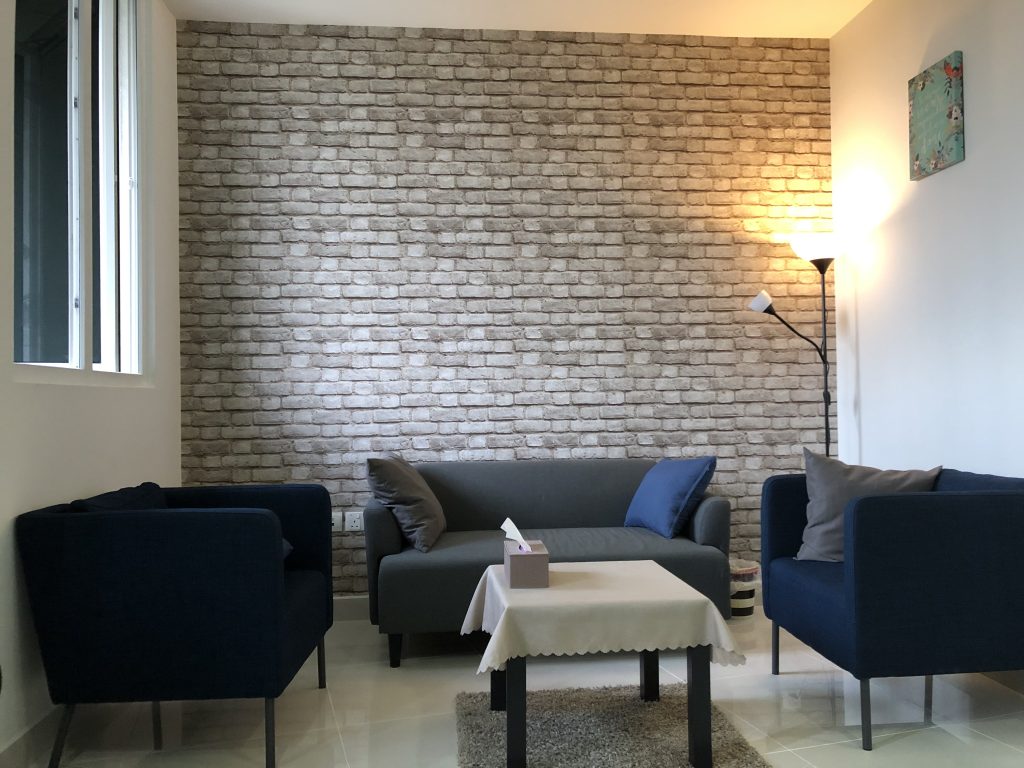
What we can tell you concretely: our entrance on Joo Chiat Road is positioned for privacy, we offer online sessions, we offer appointments outside standard working hours, and nothing leaves the room without your written consent.
We provide counselling for adults in English, Mandarin, Malay and Tamil.
This matters more than it sounds. Emotional vocabulary is usually most precise in the language you grew up in. Shame, grief, obligation and resentment are difficult enough to describe without also translating them, and something is always lost in the translation. Clients who switch to their first language mid-session frequently say more in five minutes than in the previous twenty.
Tell us your preferred language when you enquire and we will match you accordingly.
Individual counselling is one-to-one and is the right starting point for most concerns, including those that are about a relationship. You can work on your part of a dynamic without your partner in the room.
Your counsellor selects and combines frameworks based on what you are dealing with, how you think, and what you are willing to try. What follows is not a menu to choose from, but it tells you what informs the work.
The most extensively researched approach for anxiety and depression. Identifies the thought patterns driving distress, tests them against evidence, and builds behavioural change on top. Structured, practical, usually shorter-term.
For patterns that keep repeating. The same argument in every relationship, the same collapse under criticism, the same sense of not being enough regardless of achievement.
Works at the level of beliefs formed by early experience rather than symptom by symptom. Our founder is a Certified Advanced Level Schema Therapist and Supervisor with the International Society of Schema Therapy.
Focuses on the choices you are making now and the needs those choices meet, then builds better strategies. Present-focused and practical, and effective for people who find extended exploration of the past frustrating.
Treats difficulty as belonging to a system rather than an individual. Particularly relevant for intergenerational and family-of-origin work, which is a large part of adult counselling in Singapore.
Accepting difficult emotion, clarifying values, committed action.
Enquiry.Contact form, WhatsApp or phone. Tell us briefly what is going on, your preferred language, and your scheduling constraints. No referral or diagnosis needed.
Matching.We match you to a counsellor or psychologist based on your concern, language and the approach likely to suit you. If you have a preference, including on gender or age of clinician, say so.
First session, 90 minutes.Your history, what brought you here now rather than six months ago, and what you want to be different. Practical matters are covered: confidentiality and its limits, fees, cancellation. You leave with an initial formulation and a proposed plan.
Ongoing sessions, 50 minutes.Usually weekly or fortnightly to build momentum, spacing out as your emotions stabilise and you build healthy coping strategies. Most sessions seek to better help you understand your struggles and/or develop your skills to overcome your challenges.
Review.At intervals we review progress explicitly. If the therapy or counselling is progressing with your goals, we continue. If it is not, we change approach, change counsellor, or refer you out. We will discuss with you when you are ready to stop as we see you achieving your counselling goals.
Subsidised programme session
Duration50 mins
Fee$50
First consultation
Duration90 mins
Fee$180 to $280
Individual session
Duration50 mins
Fee$180 to $280
Couple or dyad session
Duration50 mins
Fee$280 to $360
Psychological assessment
DurationVaries
Fee$450 to $2,400+
Phone consultation beyond 15 mins
Duration15 min blocks
Fee$30
Rates vary with the qualifications and experience of the clinician. Sessions outside regular hours and on weekends carry an additional $40 per hour on standard rates, or $10 on the subsidised programme.
One person, for as long as the work takes. You are matched on what you are bringing, the language you want to work in, and the approach likely to suit you, and then you see the same clinician each time rather than whoever happens to be free.
Their qualifications and registrations are on their profile, because you should not have to take our word for it.


You do not need to have it figured out before you call. Not knowing how to describe the problem is a normal starting point, and working out what the problem actually is often turns out to be most of the work.
No. Adult counselling at our clinic is confidential, your records are protected under the Personal Data Protection Act, and we do not contact your employer, family or anyone else without your written consent. Our entrance is also discreet, making it much less likely for others to see you into our clinic.
In more detail:
Only in a small number of situations, and we explain these to you in the first session rather than burying them in a form.
Outside these, nothing leaves the room. One important clarification: telling your counsellor you have had thoughts of self-harm does not automatically mean your family is contacted. It means your counsellor works with you on safety, and involves others only where genuinely necessary. If this concern is part of what has kept you from booking, raise it in session one. It is a reasonable question.
Private practice generally runs $150 to $360 or more per session. Our standard individual sessions are $180 to $280 for 50 minutes, and our subsidised programme is $50 per session.
Roughly what the landscape looks like:
Generally no for MediSave and MediShield Life, which do not cover outpatient counselling or psychotherapy provided by psychologists and counsellors in private practice.
What sometimes does provide cover:
Search your policy for "psychology," "psychotherapy," "counselling" and "outpatient mental health," and ask whether a psychiatrist referral is required for reimbursement. We provide itemised receipts.
Not by the Ministry of Health. Unlike doctors and nurses, psychologists and counsellors in Singapore are currently not licensed or regulated by MOH, and the titles are not legally protected.
Registration is voluntary and self-regulated through professional bodies, so verification is on you. Check for:
At ImPossible, all our psychologists or counsellors are registered with the Singapore Psychological Society or Singapore Association for Counselling.
Yes. Our clinicians practise in Singapore and understand the specifics: filial obligation, intergenerational expectation, the demands of the local work culture, National Service, housing and financial pressure, and multi-religious and multi-racial family dynamics.
You can also request a counsellor who works in Mandarin, Malay or Tamil. And if after two or three sessions you feel your counsellor does not grasp your lived experience, say so. Requesting a different clinician is normal and we will not take it personally.
Yes to both. Tell us at enquiry if you have a preference on language, gender, age or therapeutic approach, and we will match accordingly where we can.
If the fit is not right, say so and we will rematch you internally or refer you elsewhere. Therapeutic fit is one of the strongest predictors of whether counselling works, more so than the specific method used, so this is a clinical matter rather than a matter of politeness. Give it three or four sessions before deciding, since early discomfort is common, but do not persist for months with a poor fit.
Mostly you talk and your counsellor listens and asks questions to obtain a formulation of your struggles. Nothing is demanded of you and you can answer within your comfort level. First sessions are 90 minutes rather than 50, so there is no rush.
Typically covered:
Many people find it unexpectedly relieving. Saying something out loud to someone whose entire job is to receive it, with no stake in the outcome and no reaction you need to manage, is a different experience from telling a friend.
Most adults dealing with a specific, contained difficulty see meaningful progress in 6 to 12 sessions. Longer-standing patterns take longer.
You are not committing to years. We review progress at intervals so you always know why you are still attending.
Look for changes in daily life rather than how you feel walking out of a session:
Progress is not linear, and feeling worse after a heavy session is common rather than a sign it is failing. Bring what you notice to your counsellor, including the doubts.
Yes, and for most common adult concerns research finds online counselling comparably effective to face-to-face.
Online suits people who travel, work long or irregular hours, live far from Joo Chiat, are overseas, or prefer the additional privacy of not attending a clinic. In-person tends to be better for trauma work, formal assessment, and any situation involving safety risk. You can also mix the two.
Yes. Evening and weekend appointments are available, with an additional $40 per hour on standard rates or $10 on the subsidised programme. Tell us your constraints at enquiry and we will work around them.
No referral needed, and appointments are usually available within days. A referral is only required for subsidised care through public hospitals, which needs a polyclinic or GP referral.
Contact Us
360A Joo Chiat Road Singapore 427605
© 2026 ImPossible Psychological Services. All Rights Reserved.
Directions
Overview of Location
ImPossible Psychological Services is located along Joo Chiat Road. The clinic is on the second floor of a shophouse directly above Joo Heng Restaurant. The area is famous for its iconic shophouses and for being a food haven. However, a strategic location of our entrance provides a safe and private environment for our clients.
Getting Here by Bus
16 (alight at Joo Chiat Road, bus stop code: 92179)
33 (alight opposite Marantha Hall, bus stop code: 82131)
10, 12, 14, 32, 40 (alight at East Coast Road, bus stop code: 92121 or 92129, followed by a 7 mins walk)
Getting Here By Train
Dakota MRT (CC8)
Getting Here by Car
You can come via ECP (Marine Parade exit) or PIE (Eunos exit). Proceed along East Coast Road, and enter Joo Chiat Road at the junction where i12 Katong is located.
ImPossible Psychological Services is located diagnonally opposite an open space carpark along Joo Chiat Road (J0017).